|
Cosmologists today tell us that the universe has no single
center. Its center is everywhere, every place, every
planet, every city, every species, and every person. But
we already know this.
Faith tells us that what ultimately defines us and gives
us our identity and energy is the image and likeness of
God in us. We are God's blessed ones, masters of creation,
special to God and special within creation.
And we know this long before religion tells it. Deep down,
whether we admit it or not, we each nurse the secret of
being special. And this is not just ego or narcissism but
a congenital imprint inside our very souls. Imprinted in
the core of our being is the sense that we are not just
accidental, anonymous chips of dust, almost invisible on
the evolutionary conveyer-belt, destined to flicker for an
instant and then disappear forever. We know we are more.
We, literally, feel timelessness, eternity, and immortal
meaning inside of ourselves.
In our daily lives that often causes more heartaches than
it solves. It is not easy to live out our blessed, special
status when, most of the time, everything around us belies
that we are special. As much as we experience ourselves as
special, we also experience emptiness, anonymity, and dour
ordinariness. And so it can be easy, in the end, to
believe that we aren't special at all, but are precisely
small, petty spirits, haunted by over-inflated egos.
But, while over-inflated egos do cause their share of
heartaches, it is a still an unhealthy temptation to
believe that we are not blessed simply because life finds
us one-among-six-billion-others, struggling, and seemingly
not special in any way. Faith tells the true story: We
are, all of us, made in God's image and likeness, blessed,
and our private secret that we are special is in fact the
deepest truth.
However that isn't always easy to believe. Life and
circumstance often tire us in ways that tempt us to
believe its opposite. It happened to Jesus.
He too was tempted, and there was a particular prelude to
his vulnerability:
During his baptism, he had heard his Father say: "You
are my blessed son, in whom I take delight!" Those
words then formed and defined his self-consciousness.
Knowing that he was blessed, Jesus could then look out at
the world and say: "Blessed are you when you are poor
... and meek ... and persecuted."
But throughout his life Jesus struggled to always believe
that. For instance, immediately after his baptism, we are
told, the spirit drove him into the desert where he fasted
for forty days and forty nights—and afterwards "he
was hungry." Obviously what scripture is describing
here is not simply physical hunger. Jesus was empty in
ways that made him vulnerable to believe that he was not
God's blessed child. These were his three temptations:
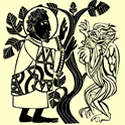
First, the devil tempted him to this effect: "If you
are God's specially blessed one, turn these stones into
bread." In essence, the devil's taunt was this:
"If you believe that you are God's specially blessed
creature, why is your life so empty?" Jesus' reply,
"One doesn't live on bread alone!" might be
rendered: "I can be empty and still be God's blessed
one! Being blessed and special is not dependent upon how
full or empty my life is at a given moment!"
The second temptation has to do with human glory and its
absence. The devil shows Jesus all the kingdoms of the
world and says: "All of these will be yours if you
worship me!" The taunt is: "If you're God's
blessed one, how come you're a big, fat nobody? Not
famous, not known, anonymous." And Jesus' reply might
be worded this way: "I can be a big nobody and still
be God's blessed one. Blessedness doesn't depend upon
fame, on being a household name!"
The third temptation follows the same lines: The devil
takes Jesus to the top of the temple and challenges him to
throw himself down to make God catch him since, in faith,
it is promised that God won't let his blessed one
"dash his foot against a stone." Jesus responds
that we shouldn't put God to the test. The temptation and
how we should resist it are both contained in his reply.
In essence, what Jesus says when the devil challenges him
to throw himself off the top of the temple to prove his
specialness is this: "I'll take the stairs down, just
like everyone else!" Our blessedness is not
predicated on having a VIP elevator, or on having any
special privileges that set us apart from others. We are
God's blessed ones, even when we find ourselves riding the
city buses.
And it is good to remember, namely, that we are God's
special, blessed sons and daughters, even when our lives
seem empty, anonymous, and devoid of any special
privileges because then we won't forever be putting God
and our restless hearts to the test, demanding more than
ordinary life can give us.
Fr. Ron Rolheiser
|