|
“The gift is not like the offense.”
A wise old spiritual director
in the British Isles is reported to have said, “There is a little bit of the
fake in all of us.”
If he was correct, his insight may have had something to do with original sin.
The Eden story was, remember, a drama woven of pretense and cover-up. Adam and
Eve were the first to bite on a big lie: the denial of our creaturely dependence.
We do seem to master the art of denial at an early age. Witness the clever words
of the “innocent” toddler accusing someone on the other side of the
room as the milk is spilled, “See what you made me do?” Soon after
infancy, we invent playmates to blame for our own blunders. “Jimmy did it.” As
teenagers we imagine some pretense, some “aura,” which will make up
for the terrible inadequacy we feel. A few put on the pose of the outsider, some
play it hot, others stay cool. The cover of designer clothes helps, as an advertisement
for Nike burbles, “Good clothes won’t laugh at us behind our backs.” Even
facing marriage, some are hounded by the fear that a future spouse might find
out what they are really like and then reject them.
We so much want to look good, to seem more intelligent or composed or virtuous
than we are. We don roles: “Father Joe Relevant,” “Sister Mary
Renewal,” “the perfect couple,” “the success story,” “the
saint,” “the picture of health.”
“Looking good is everything,” a chorus of consumer hucksters screams.
Even the postmodern halls of academe have announced the inescapable fact that
everything we do is a masquerade for strategies of privilege and pleasure. Pretense
marks the “real world” of school corridors, unfriendly streets, and
political platforms. Cover-ups not only bring down presidencies, they haunt everyday
life. As Freud said, the major barrier to healing is the wounded person who asks
for help but is secretly unwilling to face the truth that healing requires.
Is deception something we have to learn? Is it bred in the bones? Is it the fatal
flaw of every human?
Adam and Eve, we are told, had almost everything. The only drawback was the fact
that they were creatures of limit. They were good, but not God. They could have
the fruit of every tree except the tree of limits, the tree of creatureliness.
It was their creaturehood that made them susceptible to the Lie.
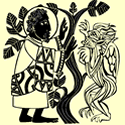
Enter the serpent, that cunning beast, that lord of lies, who taunted their obedience
and reliance on God. “Not any of the trees?” (No, they could have all
the trees but one.) “Do you not want to live forever?” (But they already
could eat of the tree of life.)
Ah, but the attraction of having no limits. To be God. To be self-sufficient,
self-made. The pretense was attractive, desirable. The ruse looked so wise.
Thus sin entered the world, St. Paul writes, through one act: the lie of self-sufficiency.
That was the offense. And it would be righted by one act as well: a life of utter
truth. That was the gift.
The temptations the devil fed to Jesus were nothing other than delusions we all
dream of in our longing for radical independence.
“Become your own food.” Be self-sufficient. Display your power. But
Jesus refuses. God alone will be his food.
“Show your stuff; muster your magic.” Leap from the temple in full
self-assurance. But Jesus will live by the word and power of God alone.
“Look out from the highest mountain and all will be given you, if you only
give yourself to the Lie.” But Jesus declines the self-adoration, reserving
glory for the Lord our God alone.
The sin of the first humans was to reject the condition of humanness: splendid
creatures, yet nonetheless dependent on God.
The gift of the new Adam was a total acceptance of humanness, an entering so
deeply into our limits, and even into the effects of our sin, that there would
be no other reality to his consciousness than abandonment to the will of the
one who sent him.
So what’s left for us, we who are neither God nor savior? Well, to receive the
truth is a great and difficult thing. That is why true confession is such a marvelous
sacrament (and so rare). If we just acknowledge the simple truth of our limits
and our sins before God and Christ’s people, we reverse the offense of Eden and
enter the gift of Calvary.
In acknowledging the lies of our own egotisms, of the great injustices of the
world, of the excesses in appetite, of the woundings in relationship, of all
the mean divisions in the church, we drop once again the heavy mask of deception.
It falls from our faces, revealing our need.
We are sinners, dear friends. If we do not know that, we suffer a poverty of
self-knowledge. But if we yield to the truth, not only that we are creatures,
but that we are in sore need of redemption, we are newly free, open to love.
We reverse the big lie of Eden as we embrace the big truth of Gethsemane, now
able to say with the one who graced our fallen state, “Into your hands I
commend my spirit.” |