Do you believe the resurrection? This is a good question to ask, at least so says St. Paul, because if the answer is no, then “our faith is in vain” (1 Cor 15:14). If it is just Jesus coming back to life the same way Lazarus did, then at the end of his life he would die anyway. No wonder so many people doubt.
Let us look at some of the doubters, especially in the Gospels.
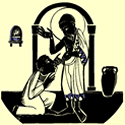
Start with Doubting Thomas. He was resentful, probably heart-broken. He warded off his grief by laying down conditions. Unless I “put my finger into the nail marks and put my hand into his side, I will not believe” (Gospel for Sunday).
And in the Gospel of Luke, the women, not the men, had seen the empty tomb and angels, but when they told about it, “these words seemed an idle tale, and [the apostles] did not believe” (Lk 24:11). In Matthew, Jesus came first to the women, but when they told the men where Jesus said to meet him, “they worshipped him, but some doubted” (Mt 28:17). In Mark, Jesus appeared first to Mary Magdalene, yet when she went to tell the apostles, you guessed it, they rejected her testimony (Mk 16:9).
Hard to miss the fact that women usually believed and men usually did not. Dan Brown tries to remedy this doubting of women in the book and movie called The Da Vinci Code. For him, males have systematically repressed the essence of Christianity. The real truth, guarded through centuries, he asserts, is that Mary Magdalene was Jesus’ secret wife. Moreover, a flesh and blood descendent from Jesus is alive today (a woman, living in secret and in fear for her life). Obviously if the Gospels are just huge cover-ups, then the resurrection would be just one more spin of the glittering wheel of deception.
Alright, what is the truth about the resurrection?
Here are some ways to think about it. First, picture a rich soil from which many plants and trees, pleasant flowers and grasses grow. Make it a perfect picture just for a second: the soil is always fallow and always ready to yield. the blossoms are always delicate and lovely, and even though they have only a short life, they will come up again when it is time. They meld into the soil and regenerate themselves.
Now make a giant imaginative leap.
Suppose we think of a soil that is not earth at all, but a much firmer, much less expected substance. Suppose it is actually the thing we call “love.” All living (and non-living) things spring up from that ground.
You will see immediately that most of us have it backwards. We think that love is something that proceeds from people who are alive. The truth is just the opposite. Life is secondary. It is only a garden plant, and it grows from a loam so rich that we hardly notice it. Love. Being alive springs up from the spiritual soil called love. Do we say that God is life, or do we say that God is love?
Jesus certainly lost his life, just as every one of us does eventually. But he was so much at one with love that his life grew again out of it.
So will ours if we go with him.
Fr. John Foley, S. J.
|