|
“I’ll never believe it.”
We have a glowing picture of the early Christian community:
one heart, one mind, no one of them claimed anything as his
or her own. So stunning was their witness that respect was paid
by all.
There were no needy in their midst, and each was provided
for according to need. Perhaps they felt, in the words recorded
in the First Letter of John, that, as believers in Jesus as
Son of God, they could take on the world.
The account of the earliest community, however—the community hidden behind
locked doors, the community hiding in fear—reveals that perhaps not all
was sweetness and light.
It is noteworthy that the first word attributed to the
risen Lord is “peace.”
One can presume, then, that this community was
somehow in a state of disquiet, And it seems that the reason was not only fear
and terrible disappointment. Quite possibly it may have been divisiveness, since
it is forgiveness that Jesus next addresses: “If you forgive others’ sins,
they are forgiven them; if you hold them bound, they are held bound.”
What is it that is to be forgiven by the gift of the Spirit’s breath?
Scripture recounts that “it happened” that Thomas was absent when Jesus
came. Later the community greets Thomas with the words, “We have seen the
Lord.” And he quite simply refuses to accept their testimony.
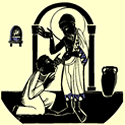
“I’ll never believe it without probing the nail-prints in his hands, without
putting my hand into his side.”
Whether this was
a major source of division or not, it is evident that Thomas
is the first Christian to dissent formally from a fundamental
conviction of the gathered church. After all, he does not
believe in their testimony to the Resurrection.
Despite the wound of this division, however, Thomas remains with the community
and they seem to welcome him. In fact, the next time Jesus appears in their
midst, a week later, Thomas is present. And Jesus speaks directly to him: “Do
not persist in your unbelief, but believe.”
I have found this a fascinating and rather challenging narrative. Even if forgiveness
is not the theme of the Thomas incident, it is clearly the case that Thomas
is with the community he so profoundly challenges.
I’m afraid that if I had been running the church it might have been otherwise.
I
find in myself strong inclinations to exclude from the category of believers
those who seem to reject significant parts of our doctrine and practice. And
yet, the example of the resurrection community undermines such an attitude.
Thomas was not excluded.
He was not kicked out or given an either-or choice
concerning the Resurrection of Christ. He was welcome. Apparently, he was forgiven,
not bound, even though at the time he had not yet recanted his heresy.
I wonder what this might mean for a church that has strong tendencies to exclude
the marginal.
Again, I am not constitutionally inclined to take much delight in such an observation,
but the evidence of the text warrants it. And it says something important to
us all.
We have not a few liberals and conservatives who act as if the presence
of the other side is a contaminant in the church. There have been wars and
persecutions mounted in the name of dogma. There have been excommunications
and interdicts in the name of right practice.
Divisions have wounded the church
and injured our witness in faith. The passion for being right has served the
cause of ego at least as much as it has served the cause of Christ.
Does this mean that anything goes, that there is no cause or truth worth standing
up for and making divisions over? Is it an invitation to the chaos of diversity
without any center or unity? Not necessarily.
What provided the occasion for the renewed entry of Jesus into the community
was the fact that they were gathered together in his name. At least Thomas
had not hardened himself to their testimony. At least he had not put himself
out of and above the church. He may have had the attitude of a dissenter, but
it was in the context of Christ as the center of their relationship. There
is division, but there is also humility and openness.
Jesus says to the Thomas in us: “Enter the wounds: the wounds of my humanity,
of my church, of my crucified body, my risen body and my mystical body”
And the reply of
Thomas, the doubter, the unbeliever, the skeptic? In the
strongest divinity text of the New Testament, albeit a text
probably appended later, he says, “My Lord and my God.” Such
is the transformative power of resurrection faith.
“These have been recorded to help you believe that Jesus is the Messiah,
the Son of God, so that through this faith you may have life in his name.”
May they help us believe. And forgive.
|