|
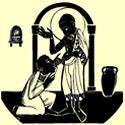
After eight days Jesus
came in and stood among them.
Thomas’ profession
of faith came swiftly when, eight days after he had declared
his unwillingness to believe, Christ showed him his side
and the nail marks in his hands and removed every possible
doubt.
Our Lord Jesus Christ had miraculously entered the room when the doors were
closed. As this would have been impossible for an ordinary earthly body he
reassured Thomas, and through him the other disciples, by letting him see his
side and the wounds in his flesh.
Only Thomas is reported to have said: "Unless my hands touch the marks of
the nails and I see them, and unless I put my hand into his side, I will not
believe"; yet to some extent all the disciples were guilty of disbelief.
Doubt remained in their minds even after they had told Thomas that they had
seen the Lord.
Saint Luke’s account says that, "while they stood amazed, torn
between joy and disbelief Christ said to them: “Have you anything to eat?” They
gave him apiece of broiled fish and part of a honeycomb, which he took and
ate before their eyes."
This surely proves that it was not only in the mind
of blessed Thomas that disbelieving thoughts still lurked, but in the minds
of the other disciples as well. It was their very astonishment that made them
slow to believe, but when it became impossible to disbelieve what they could
see with their own eyes, blessed Thomas made his profession of faith: "My
Lord and my God."
Jesus said to him: “Because you have seen me, Thomas,
you have believed. Blessed are those who have not seen, and
yet believe.”
There was a wonderful
providence behind these words of the Savior, and they can be of very great
help to us. They show once again how much he cares for our souls, for he is
good and as Scripture says: He wants everyone to be saved and to come to knowledge
of the truth.
Even so, this saying of his may surprise us.
As always, Christ had to be patient with Thomas when he said he would not believe
and with the other disciples too when they thought they were seeing a ghost.
Because
of his desire to convince the whole world, he most willingly showed them the
marks of the nails and the wound in his side; because he wished those
who needed such signs as a support for their faith to have no possible reason
for doubt, he even took food although he had no need for it.
But when anyone accepts what he has not seen, believing on the word of his
teacher, the faith by which he honors the one his teacher proclaims to him
is worthy of great praise.
Blessed, therefore, is everyone who believes the
message of the holy apostles who, as Luke says, were eyewitnesses of Christ’s
actions and ministers of the word.
If we desire eternal life and long for a
dwelling place in heaven, we must listen to them.
(Commentary
on John’s Gospel 12, 22: PG 74, 729-36)
Cyril
of Alexandria (d. 444) succeeded his uncle Theophilus
as patriarch in 412. Until 428 the pen of this brilliant
theologian was employed in exegesis and polemics against
the Arians; after that date it was devoted almost entirely
to refuting the Nestorian heresy. The teaching of Nestorius
was condemned in 431 by the Council of Ephesus at which
Cyril presided, and Mary’s title, Mother of God, was solemnly
recognized. The incarnation is central to Cyril’s theology.
Only if Christ is consubstantial with the Father and with
us can he save us, for the meeting ground between God and
ourselves is the flesh of Christ. Through our kinship with
Christ, the Word made flesh, we become children of God,
and share in the filial relation of the Son with the Father. |