|
A rubric in the Roman Missal notes that three principal mysteries
are commemorated in this Mass and should be explained in the
homily:
the institution of the Eucharist;
the institution of
the priesthood;
and Christ’s commandment of brotherly love.
The first is covered
by the first and second readings; the second, by the gospel;
the third is implicit in all three
readings. The readings are the same every year.
Reading
I: Exodus 12:1-8, 11-14
Although it is much disputed whether the Last Supper was a
Passover (so the Synoptic Gospels) or a meal preceding the
Passover by twenty-four hours (so John), two things are certain:
the original meal of Jesus and his disciples was undoubtedly
surrounded by Passover associations, and the accounts of the
institution have been impregnated with paschal theology, both
in Paul (see the second reading) and in the Synoptists.
Preeminently,
too, the Israelite Passover provided the background for the
annual Christian feast, and therefore most especially for the
Easter Eucharist at the conclusion of the vigil. It is therefore
doubly fitting that the Triduum should begin with this reading.
Three points may be made here. (1) The Passover is an (annual)
memorial of the great redemptive act of God that constituted
God’s first people. “Memorial” means more than mentally
recalling. The devout Jew believed that at the celebration
of Passover he or she was actually coming out of Egypt with his or her
ancestors.
The same realism colors the Christian Eucharist and preeminently the Triduum.
(2) The shedding of the blood of the lamb provided an obvious type for the death
of the Lamb of God, who takes away the sin of the world. For the Christian dispensation,
the bloodshedding is more than a ritual or cultic act—it is a moral act
(Hebrews 10:5-10) that becomes an event of salvation history. It is the making present
of this event that is one of the main meanings of the Eucharist.
(3) The Passover (meal) was eaten in great haste and expectation. In the course of centuries,
this sense of urgency was transformed into an expectation of the Messiah, who
was to come that night. The early Christians likewise began their Passover celebration
looking for the coming of Christ, and even when the Second Coming did not occur,
they believed that he came in the Easter Eucharist in anticipation of his final
coming (Marana tha!). |
|
|
|
Responsorial Psalm: 116:12-13, 15, 16bc, 17, 18
This psalm underlines
two aspects of the Eucharist: the sacrifice of thanksgiving
and the communion among believers, a sharing of the cup.
Some traditions have overemphasized the one to the exclusion
of the other. The Eucharist is both together.
|
|
|
|
Reading II: 1 Corinthians 11:23-26
This is one of the earliest fragments of Christian tradition
preserved in the New Testament (see also 1
Corinthians 15:3-7). Paul
says that he “received” it before he “handed it on” to the Corinthians about 50 C.E., and the words for “receive” and “hand on” represent
words for the passing on of tradition as in rabbinic practice.
So we are dealing here, not with a vision “received from
the Lord,” but with a tradition handed down through human
witnesses, though always under the supervision of the exalted
Christ.
This is not a complete description of the Last Supper but a
liturgically stylized account, selecting and interpreting those
features of the meal that were of importance for the Christian
Eucharist.
Its mention of the supper between the bread and the cup indicates
its primitive character. Only Paul and the long text of Luke
mention the command to repeat it in memory of Christ, but the
other accounts presume this by their very existence, for they
were recorded precisely because the church was “doing
this” as a memorial of the Lord.
Paul also preserves what is more prominent in the Synoptic
accounts, the anticipation of the Second Coming. In Paul,
as in the Synoptists, the Eucharist looks both backward and
forward—backward to the redemptive event of the Cross
here made present, and forward to the Second Coming here anticipated.
|
|
|
|
Gospel:
John 13:1-15
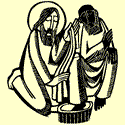
The theme of brotherly love is introduced at the footwashing,
as the Lord says: “I have set you an example, that you
also should do as I have done to you” (13:15). This example
is further defined later in the discourse, after the supper: “I
give you a new commandment: that you love one another just as I have loved
you” (13:34, the versicle before the gospel; the Latin
mandatum gave this day its traditional English name of Maundy
Thursday).
Modern exegetes find two themes in the footwashing,
the first symbolic, the second
exemplary. The symbolic meaning asserts that Jesus lays aside
his garments as a parable of humiliation. He stooped, first
to become incarnate, then to die in order to cleanse humankind
of sin; finally he returns in glory to the Father.
The whole
incident is an acted parable of the Carmen Christi (see
the second
reading of Passion Sunday). The symbolic meaning
is
expressed in verse 3: “Jesus, knowing that the Father
had given all things into his hands, and that he had come from
God and was going to God . . . .”
The exemplary meaning
is expressed in verse 15: “For I have set you an example,
that you also should do as I have done to you.”
|
Reginald H. Fuller
|
Copyright © 1984,2006
by The Order of St. Benedict, Inc., Collegeville, Minnesota.
All
rights reserved. Used by permission from The Liturgical
Press, Collegeville, Minnesota 56321 |
Preaching the Lectionary:
The Word of God for the Church Today
Reginald H. Fuller and Daniel Westberg. Liturgical Press. 2006 (Third Edition), pp. 63-65.
*Webmaster Note: Commentary on the Responsorial Psalm
is from the 1984 Revised Edition, p. 59. |
|

Thank
you to Liturgical Press who makes this page possible
|
|
For more information about the 3rd edition (2006) of Preaching the Lectionary click picture above. |

Art by Martin Erspamer, O.S.B.
from Religious
Clip Art for the Liturgical Year (A, B, and C).
Used by permission of Liturgy Training Publications. This art may be reproduced only by parishes who purchase the collection
in book or CD-ROM form. For more information go to: http://www.ltp.org/ |
|
|
 |