|
Now
he showed how perfect was his love.
How faithful a friend is Christ Jesus, a friend never unmindful
of his own! Because "he loved them to the end" he gave
them, as he was about to die, the uttermost proof of his love.
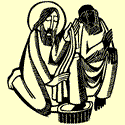
Falling
down before them he washed their feet, in order to leave both
to them and to all his followers a supreme example of humility;
and accordingly he told them, "I have given you this example
so that you yourselves may deal with others as I have with
you."
After that, we have no grounds for pride, creatures
of earth and ashes as we are, since the God of eternal majesty
has so abased and emptied himself as to perform a slave’s office.
He went further, and gave a yet greater sign of his love by
instituting this wonderful sacrament as a
memorial of his sacred death. "Take this", he said: "This is my body, which will
be delivered up for you. Do this in memory of me."
These
are burning words indeed; what ardent charity breathes through
them! "Do this
in memory of me." Let it be to you a memorial of my whole
life of shining purity, and a mirror of my laborious passion.
Yes,
I tell you, I have engraved you on my hands; more than that,
the lance has carved you upon my heart, and I long to carry
you in my inmost being as in a mother’s womb. Respond to me,
then, by celebrating this memorial of me and receiving my sacred
body.
Let us make haste, dearly beloved, to wash our feet as speedily
as we may, and with tears expunge the stains
from our hearts by repentance, so that we may worthily approach
the table of
the King of Kings, Christ Jesus.
As we eat the living bread
which "has come down from heaven," may he find us fit
to draw from this divine food the richest of benefits.
Christ
Jesus
himself has promised that "whoever eats this bread will
live for ever"; may he then bestow this life upon us by
his most gracious mercy, who lives and reigns with the Father
and the
Holy Spirit for all eternity. Amen.
(Sermon 22 on Holy Thursday: Opera I, 456-57)
Alonso de Orozco (1500-91)
studied at the University of Salamanca before entering the
Augustinian novitiate there. His main apostolates
in the Order were preaching and writing, and although he was
chosen as royal preacher at the Spanish court, he preferred
to speak to poor and simple people. His religious life was
marked by a spirit of fraternity, gospel simplicity and moderation
in speech. As an ascetic and great mystic, he suffered crises
and spiritual aridity from 1522-51. He was beatified by Pope
Leo XIII in 1882.
|